200. $1200
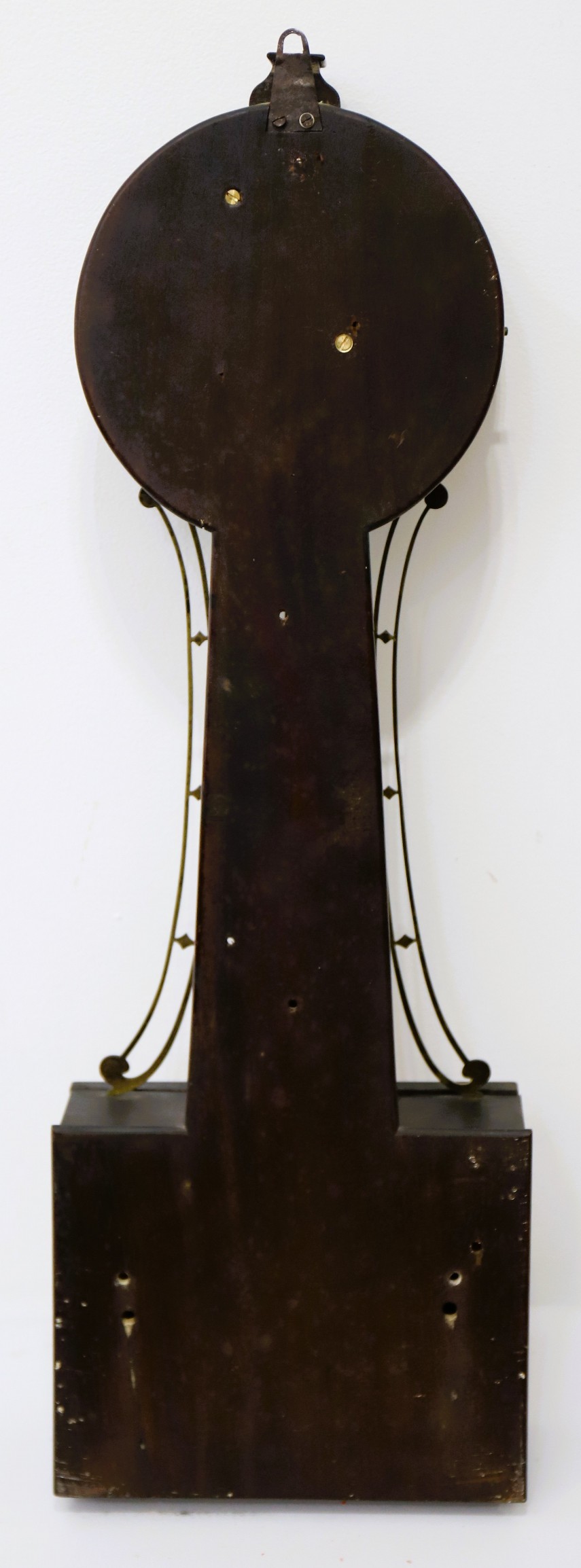
Early Patent Timepiece, ca. 1820. An early banjo from
the “Willard school”, but I am unable to identify a maker. The 30-inch mahogany case has an old/original finish and thick patina;
a brass globe finial on top that is old, a convex dial glass that is probably a replacement in a heavy brass bezel, and two original
glasses in the throat and box, with the original painted tablets. I believe there has been some touch-up to both glasses, particularly
in the box-glass gilding, with two apparent spot-losses; the red banner on the box tablet states, “Willard Patent”. The box
glass has a vertical crack with a horizontal crack to the right, both of which have been repaired and stabilized. The door latches
with an L-turn. The throat piece is mounted to the frame with two fillister head screws about two-thirds of the way down. There are brass side arms. The iron dial holds very old/original paint with some fading to the numbering; there is no indication
of a signature, and I see no writing on the back of the dial. It is held in place with three L-turns and the iron
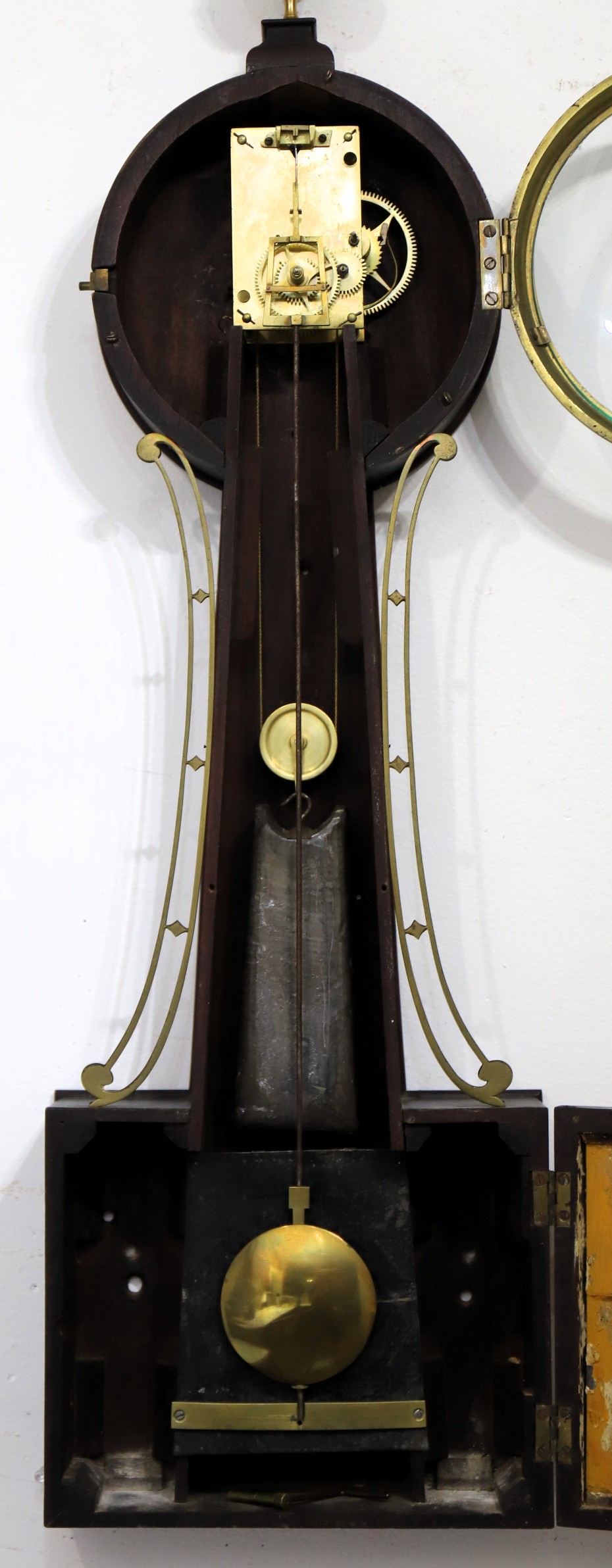
barbed arrow hands are finely carved. The 4-inch brass plate movement is mounted with two diagonal through-bolts and has a centered
T-bridge suspension; the keystone pendulum has a crossbar. The click-pawl is distinctive but does not identify a maker, as I
can find a similar example on a clock by William Cummens (Foley, Willard’s Patent Time Pieces, page 34) and on a clock by Aaron Willard,
Jr (ibid., page 51). Both makers used T-bridge suspensions. There is a large brass pulley and a duck-bill lead weight. The tin weight shield is unmarked, the pendulum tie-down clip is missing. I see no markings on the case or frames but note that
the beveled glue blocks in the box match those used by A. Willard Jr, including blocks adjacent to the hinges (ibid., page 51). The clock is running nicely. $1200–$2500.


Antique American Clocks January 2026