
54. $250
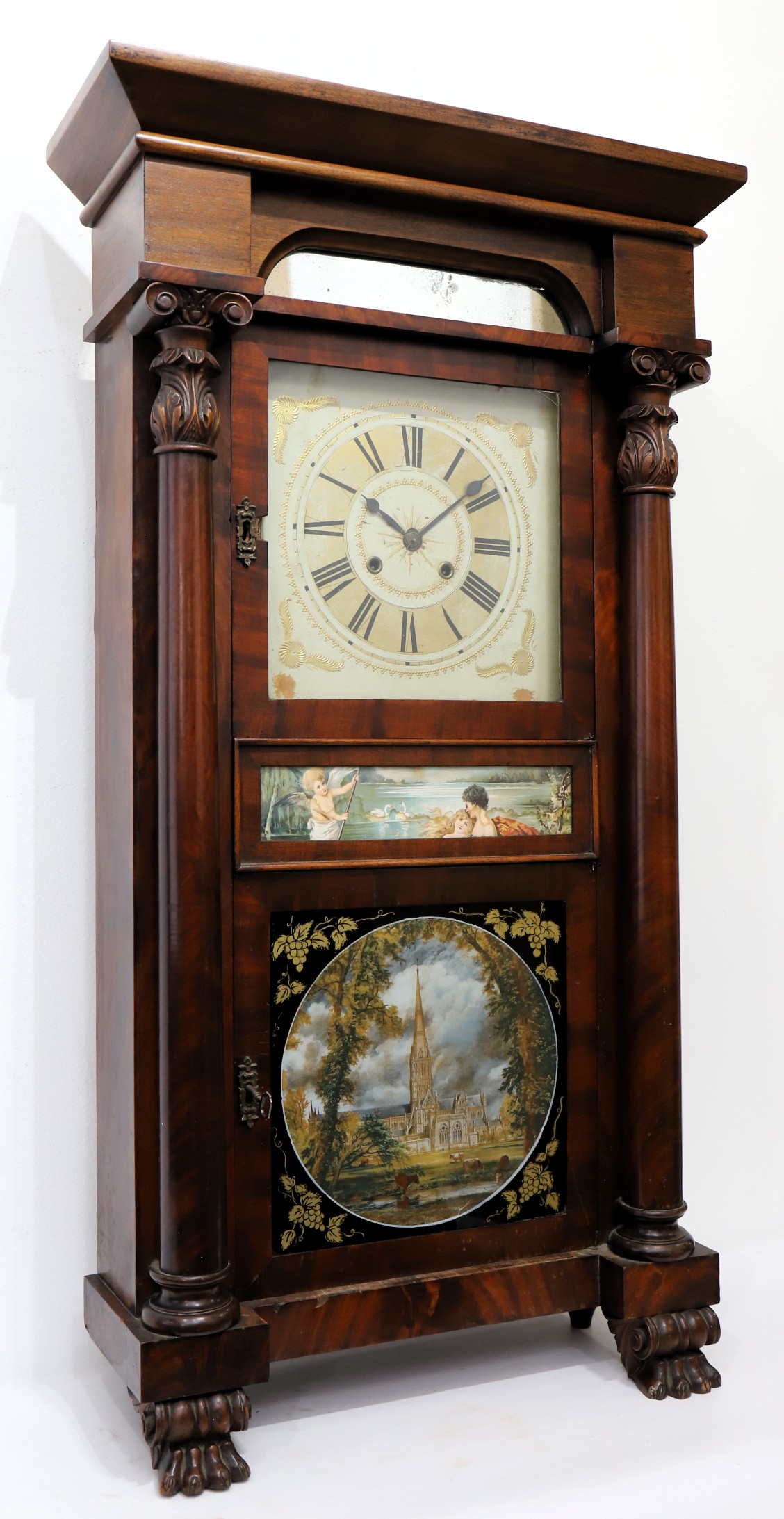
Marshall & Adams Empire shelf clock, 1834-1836. Chauncey
and Elmer worked out of Seneca Falls, NY, midway between Syracuse and Rochester; Chauncey had the money and Elmer the ability. Elmer
bought out Chauncey in 1836 and continued in business on his own for a year, until the economic crash of 1837 put him out of business. They
manufactured both wood movement and brass movement clocks concurrently, the brass clock movements for the high-end market. Their
cases were modeled on those of Asa Munger, upstate New York’s most successful clock manufacturer. They (Adams) made two
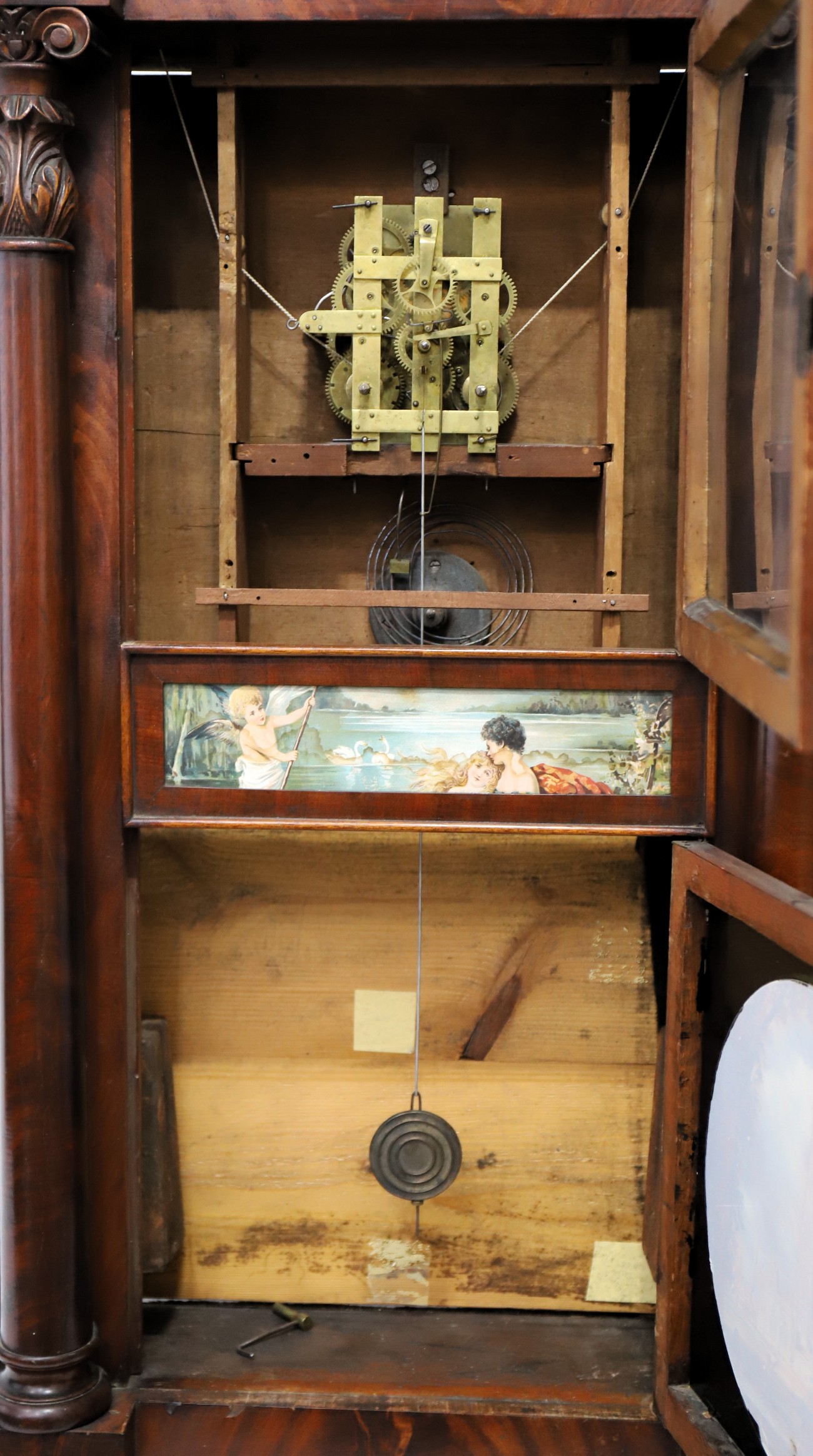
8-day brass movements, one based on Joseph Ives’ strap-brass movement, and a second much less common movement based on an S.B. Terry
movement. The latter is the movement used in this clock. The case is 40.5 inches tall with the cornice section
of the clock being a modern replacement (note the difference in coloration, probably because the cornice is walnut and not mahogany-veneered). Most of the case is veneered in mahogany, with figured mahogany used on the sides and columns. It stands on two large paw feet
in front and turned feet in back. The cornice mirror is period, the dial glass original, the middle glass period and backed
by a printed image; the lower glass is period with a modern applied image and surround and is held in place with glazier’s points
without putty. The wooden dial has been aggressively cleaned, leading to some loss of gilding in the dial ring; the hands are
not typical of these makers. The unsigned brass 8-day, time-and-strike movement runs for a while and then stops, and I can’t
get the strike chain to run. There are two large iron weights and a period pendulum bob. I believe that this clock
originally had a reverse-painted glass inside on the backwall and hence, the peculiar backboard that clearly had something mounted
in front of it, and no label. AAC sold a very similar example with a reverse-painted glass of Saratoga Springs in 2024; if this
clock were in better condition with an interior glass it could bring $1500. $250-$400.


Antique American Clocks January 2026




Looking for an easy way to save the clocks you like?
Here's an easy way to keep track of your favorite clocks: Open/download the Bid Form PDF onto your computer (it should open in a new window) and type in the clocks you want to save. Right click to 'save as', or click the download arrow in the top right corner of your browser window, and you can save the filled-in form on your computer - I recommend your desktop. It will be easy to find and you can open it any time to add or subtract clocks from the list. When you are ready to go, your bid form will be too!
Antique American Clocks - What's not to like?