
38. $400
Riley Whiting
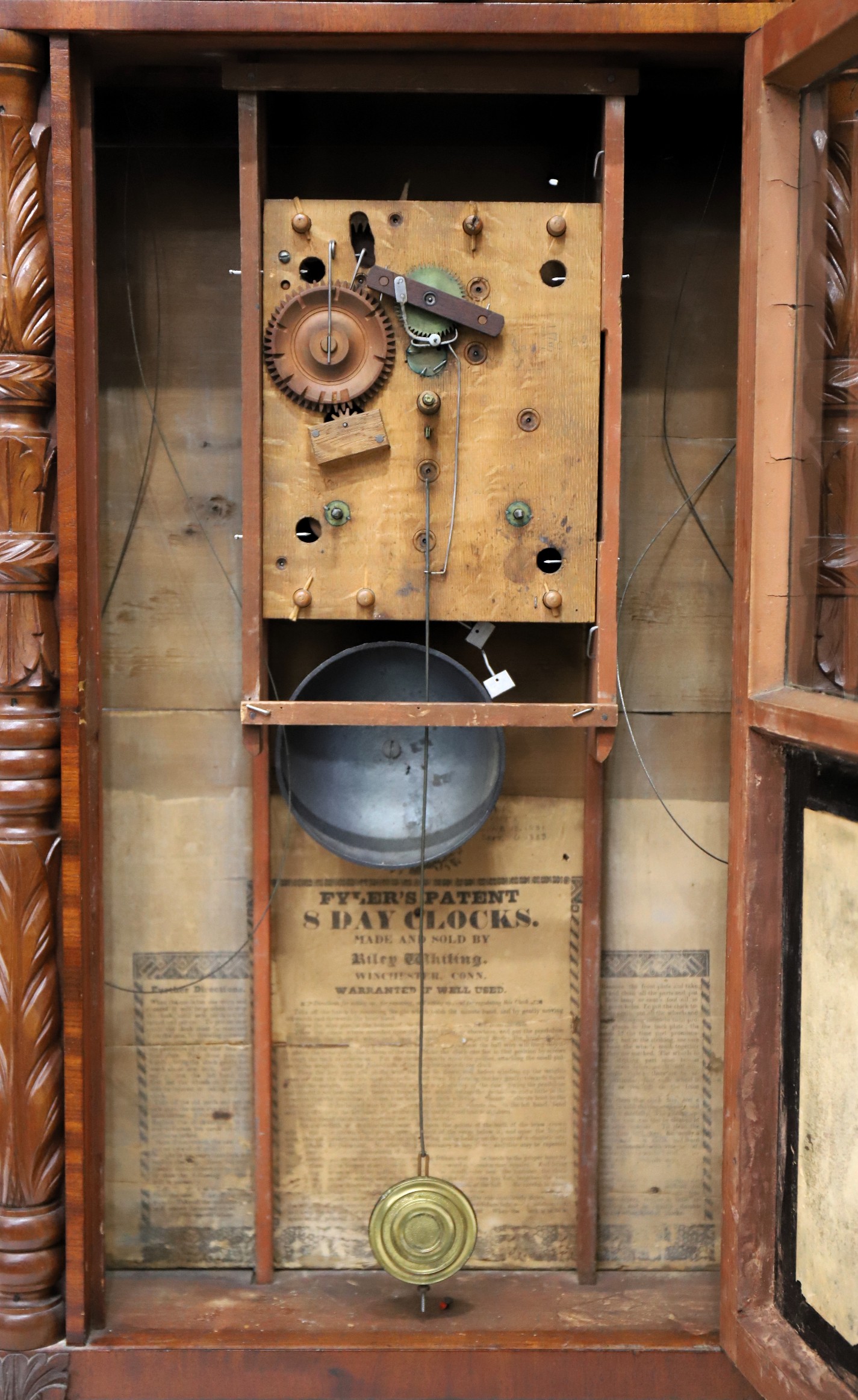
carved column & splat with Fyler’s 8-day movement, ca. 1833. It looks like a standard 30-hour short-drop clock but it has
some special sauce, a wooden movement made or modified by Orsamus R. Fyler to run 8-days in a 25-inch cabinet (the overall height
of the clock is 32.5 inches). Fyler was not a prolific maker and it is not clear how many clocks bear his movement, either under
his name or under Riley Whiting’s name, as this one is. Fyler had two patents for wooden movements: one for a temperature-compensated
pendulum, and one for an 8-day movement that would run in a short-drop case, as found here. Because both patents were lost in
the Patent Office fire of 1836, we don’t know the details. His work was first described by Paul Hollingshead in a 1954 article
in the Bulletin of the NAWCC (Vol. 6, Issue 56, Dec 1954, page 313) where Hollingshead describes this actual clock; Fyler’s 8-day
movement is described in some detail by Bruce Burns in the February 1970 issue of the Bulletin (Vol. 144, page 129). How did
he adapt a (Riley Whiting) 30-hour wooden movement to run for 8 days? That isn’t entirely clear. In addition to some changes
in gearing, and some changes to the front plate and escapement, Fyler incorporated the use of two hammers for the strike, thereby
halving the number of revolutions needed per strike. The presence of two strike hammers was the first clue I had with this clock
that something was not typical. More importantly, Fyler compounded the weights and used heavier weights. Unfortunately,
this clock no longer has the proper lead weights (estimated at ~6 lb) nor the bottom pulleys on which to hang the weights. (I
can provide two approximately correct cast iron weights for $25 – put a note on your bid sheet if you want them).
As noted,
the mahogany case is 32.5 inches tall with a clean refinish and carved half-columns and eagle splat. It stands on small paw
feet in front and turned feet in back. The dial glass is likely original, the lower glass is likely an early twentieth century
replacement with a gilded border and a paper image of a past President pasted into place. The wooden dial is clean with a gilded
chapter ring and penciled notes on the back from various early owners. The hands are proper. The wooden movement was not
tested as there are no bottom pulleys for the weights; in addition, there are missing teeth on a pinion gear on the strike side. There is a cast iron bell and a period pendulum bob, as well as a very good label inside noting Fyler’s contribution to this Riley
Whiting clock. There are tin dust covers on the top but they are probably later replacements. There are no sales of Fyler
clocks on LiveAuctioneers or the Antique Clocks Identification and Price Guide, but Cottone’s sold a similar example in 2012 for $1700,
and Skinner’s sold one in 2008 for $1896. $400–$800.


Antique American Clocks January 2026


