27. $450
Asa Munger &
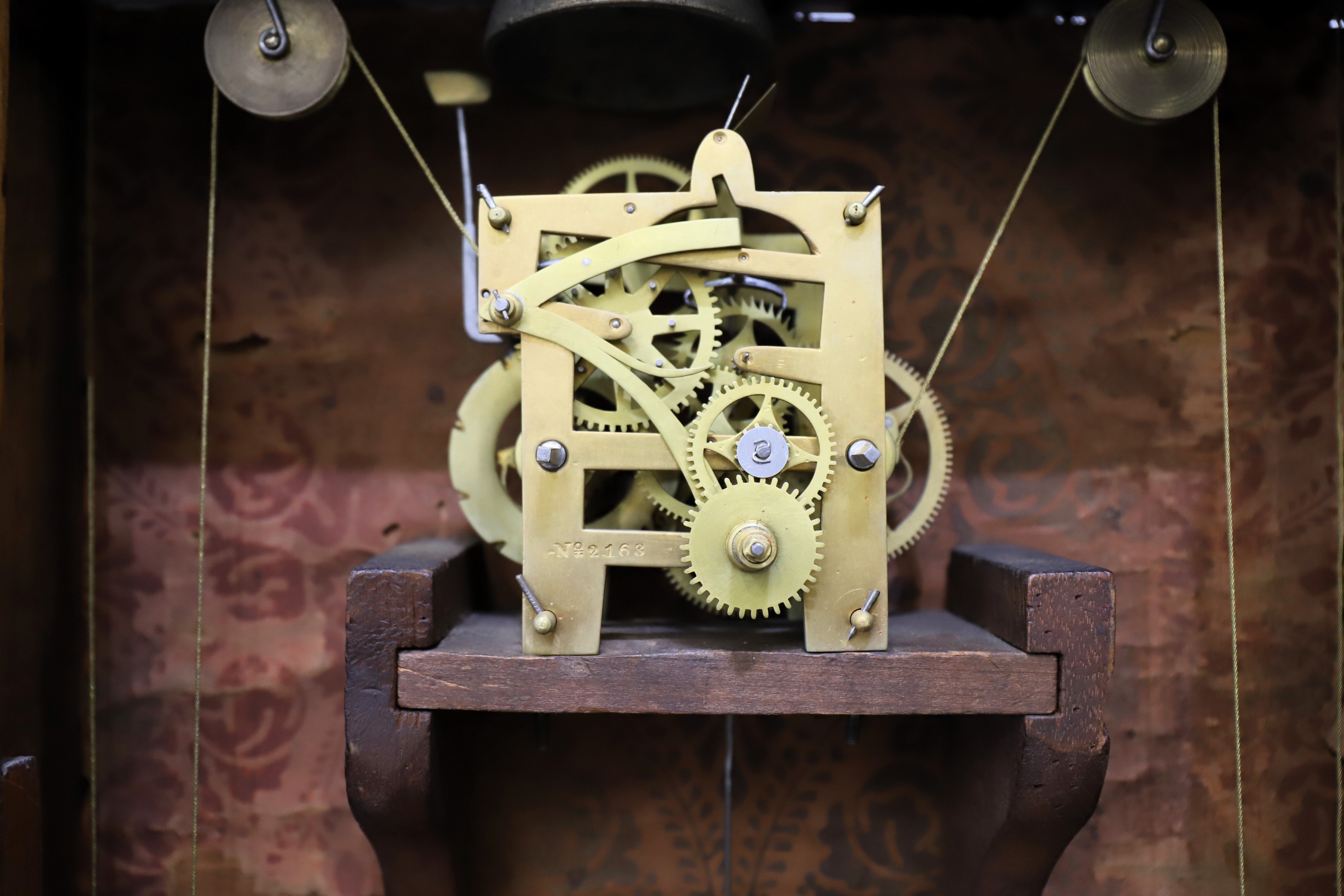
Co. shelf clock, 1833-1834. This business was formed when Clark Hotchkiss joined Munger and Thaddeus Benedict in Auburn, NY. Benedict was a jeweler; Hotchkiss was a clothier. It was about this time that Munger began using prison labor to make clock
movements, and Hotchkiss had previous experience with prison labor. A year later Munger sold out to Benedict and Hotchkiss,
who continued to use prison labor until 1839. Munger switched to silversmithing with his son. Inmate-made movements were
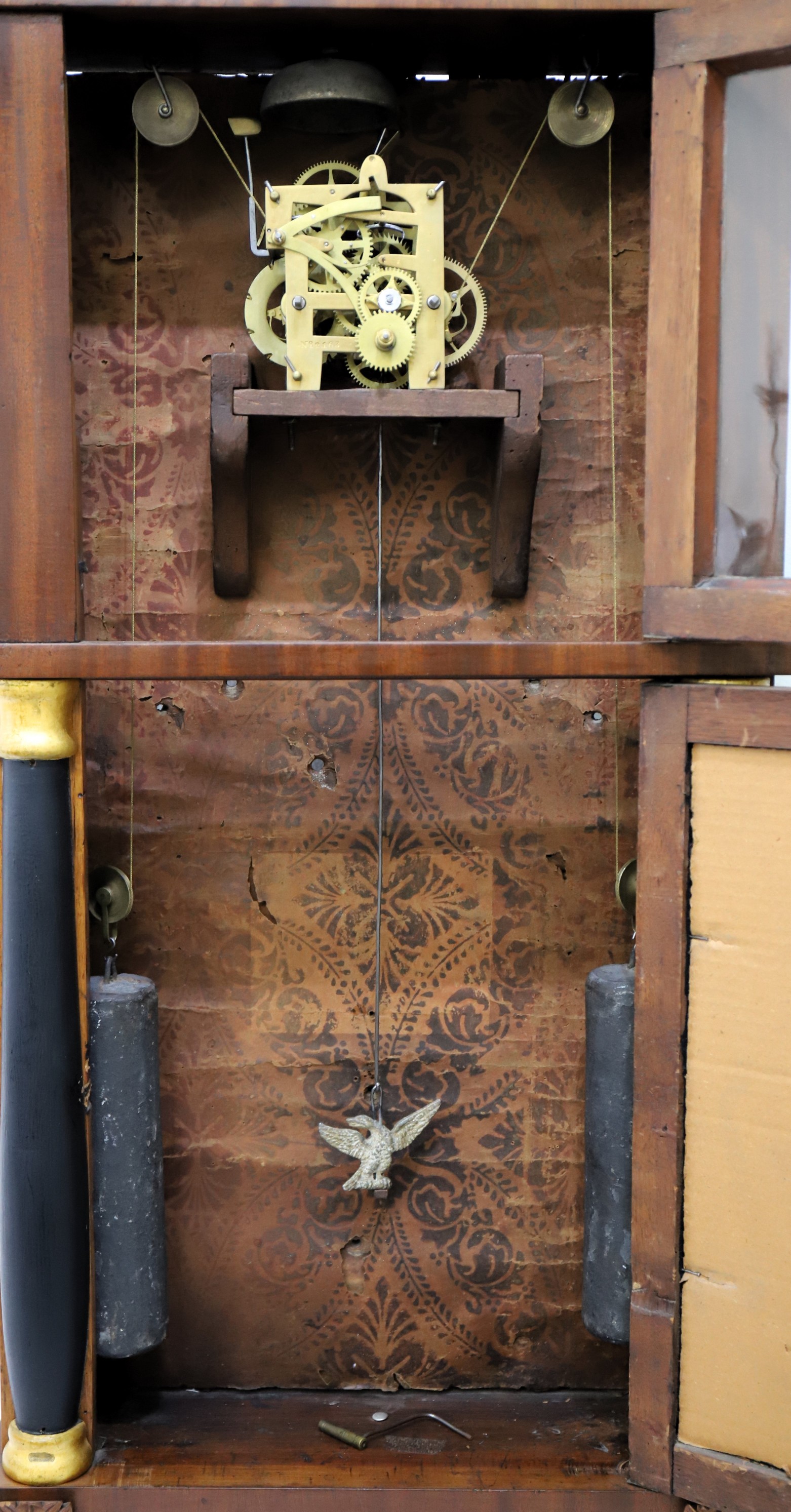
numbered; this one is number 2163. The case is 39 inches tall with mahogany veneer on the front (but not the sides) and a carved
splat. The half-columns on the bottom have been painted, as have the capitals and plinths. The dial glass is original
and cracked; the mirror looks like early twentieth century and is backed by cardboard. The wooden dial has been repeatedly varnished
and is badly yellowed; the varnish can be removed with alcohol if you want to try to restore it. It bears the ‘A Munger &
Co.’ stamp below the mainstem. The hands are brass but I am not sure if they are original; the seconds hand that should be in
the open circle above the mainstem is missing, but the spindle is there. The brass 8-day, time-and-strike movement is running
and striking on the overhead bell, regulated by the characteristic eagle pendulum bob. The long round weights are also correct
and likely original, suspended on four brass, unmarked pulleys. The backboard is wallpapered, as is typical, but the maker’s
label usually found behind the pendulum bob is lost (you can see the shadow where it was). I can find no sales records for this
model by Munger & Co, perhaps not surprising given the short time-frame in which this group worked. Similar Munger &
Benedict clocks sell for over $1000 (e.g., here). $450–$900.


Antique American Clocks JULY 2024